
Archive feature · personal selection
My Favourites
Tomasz Kurdziel’s subjective list
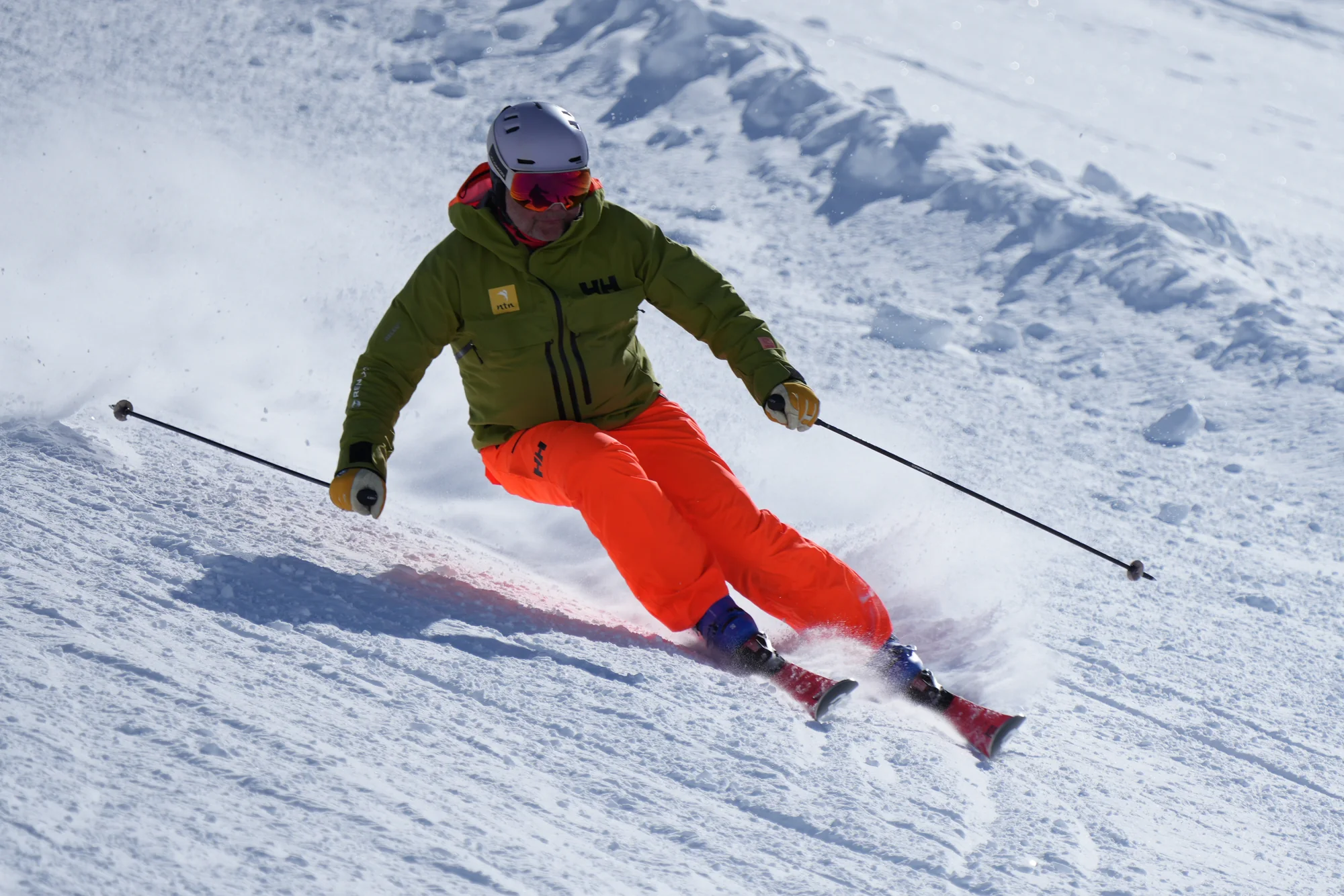
Heading into another season – as always – I am presenting my completely subjective top ten pairs of skis, plus a small bonus, that made the greatest impression on me during the Independent Ski Test and on other occasions when I had the chance to try them. The word “subjective” deserves emphasis. We all have our own preferences when it comes to terrain, conditions and skiing style – the turn radius we use most often and the balance between pure carving and “skidded” skiing.
I have to admit that the way I ski has evolved over the years. I once loved short- and medium-radius carved turns, so fun-carvers and modern slalom skis were the natural choices. These days I tend to ski medium and long turns, on the assumption that making fewer turns over a given distance gets me to my favourite double espresso sooner. I still believe I ski in a modern and fairly dynamic way. My average speed has not dropped either – except perhaps in poor visibility, when I have simply become more cautious. I enjoy skiing off piste, but only when both the conditions and visibility are good.
During the Independent Ski Test itself – and throughout the following week – I unexpectedly hit what I can only call a “horsepower spell”. I was skiing as well, as effectively and as dynamically as I had at least 15 years earlier. I hope it was not the proverbial “swan song” and that for several more seasons I will still be able to regale you with my choices for My Favourites.
1st place · 175 cm
BLIZZARDFIREBIRD HRC

It is no accident that these skis have made My Favourites for the second time in three seasons – and this time they take first place. Two seasons ago they lost by the narrowest of margins to Nordica’s Multigara. Back then, however, I tested a pair fitted with a heavy and stiff race plate-and-binding set-up that demanded a great deal of strength. Last year the Firebird HRC arrived at our test with an FDT plate – still made of plastic – which, in my opinion, slightly reduced the ski’s effectiveness on ice.
At our latest test, everything finally came together. From the 2025/2026 season, Blizzard’s race-oriented skis are fitted with the new aluminium FDT Race Plate Pro B. What is more, the interface between the plate and bindings is completely free of play, which greatly improves steering precision. In my view, this is the optimum combination: you can ski with exceptional accuracy without having to wrestle with the skis.
The Blizzard Firebird HRC is most willing and effective in medium-radius carved turns. It initiates readily, but never – heaven forbid – nervously, and tracks through the arc with great stability. Even on a very hard piste, the skis never vibrate or chatter, which gives them fantastic edge grip. Their flex pattern is absolutely spot-on. On the one hand, they guide turns with extraordinary harmony – silky smooth and even comfortable – while on the other they offer plenty of energy. Load them properly and they return that energy superbly at the end of each turn, propelling you into the next. Together with the relatively narrow waist, this also makes their edge-to-edge transitions lightning-fast.
Their stability is high enough for long-radius turns at serious speed. Driven hard through the shovels, they can also carve surprisingly tight turns for a ski of this length, although doing so requires real commitment. In skidded turns they are predictable, easy and still lively. What more could you ask for? Perhaps only this: they deliver immense joy and keep a permanent grin plastered across your face – which is exactly why they sit at the top of my list. A highly successful ski for advanced and expert skiers with sound technique, intended for all-day use on well-groomed and preferably firm pistes.
2nd place · 182 cm
SALOMONS/RACE GS PRO

This Salomon model has been on the market for some time, and I hope it remains in the range for several more seasons. For some reason, I have never had much luck with these skis in our tests… In previous years, Salomon’s representatives entered the S/Race GS PRO in the Giant Slalom category in a 175 cm length. That was a major mistake, because in that size the ski excels among race-bred hybrids, setting the benchmark for the category as if it had been lifted straight from Sèvres outside Paris.
But let us get to the point. The version that captivated me is 182 cm long, has a very narrow 65 mm waist, a turn radius of just 17 metres and a race-style sandwich construction with two layers of aluminium around a full-length ash core. In theory, this recipe should not work particularly well. A 116 mm shovel – and therefore a tight radius for a ski 182 cm long – suggests that the skis will hook into turns very quickly, perhaps too quickly, making smooth skiing with rhythm changes difficult to achieve. Nothing could be further from the truth.
The 182 cm S/Race GS PRO is a performance machine designed for long- and medium-radius carved turns, and it is astonishingly smooth in both. Whatever the radius or speed, the ski feels exceptionally secure. Its phenomenal grip provides a rock-solid platform that lets you send your legs a long way out from beneath you – and do so safely. It does not vibrate, chatter or shake. Edge-to-edge transitions are extremely quick and energetic. Oh yes – the pleasant kick at the end of every turn makes you feel a little like a leading World Cup GS racer.
Changing rhythm between long and medium turns is very easy. The grip is so good that it encourages you to push your limits and learn something new. The ski also masks speed exceptionally well, so you may suddenly realise that you are travelling much faster than on other models in this category.
Does it have any weaknesses? It certainly does. This is, after all, a 182 cm GS ski, so its manoeuvrability is limited in piles of pushed-up snow, moguls and narrow sections. It is also fairly stiff, which does not help agility. On top of that, it needs to be skied very actively. I regard that as an advantage, but anyone looking for a single, comfortable pair certainly will not.
Even so, these are superb GS skis for experts who like – and know how – to charge flat out through long- and medium-radius carved turns on well-groomed or even icy pistes. They are also ideal for amateur GS training and racing.
3rd place · 174 cm
ATOMICREDSTER X9 RS REVOSHOCK S

Third place goes to a genuine newcomer. As you probably know, Atomic is celebrating its 70th anniversary this season. To mark the occasion, the Redster line has been completely renewed, and the new generation received a very warm welcome from our testers.
As regular readers will also know, I was never a great fan of the previous Redster X9. Do not misunderstand me – it was never a bad ski. I simply maintained that its tails were too stiff, and I said so both in our tests and in videos on our YouTube channel. The situation is very different now. The Redster X9 has received slightly revised geometry, a new construction and new binding plates in both the “S” and “RS” versions.
When I tested Atomic’s collection in Flachau, I preferred the less demanding “S” version after just two short runs. At the Independent Ski Test, I changed my mind completely. The Redster X9 RS is equipped with the latest generation of race bindings and plates. Those Icon plates are a genuine piece of engineering brilliance. They help every Atomic – and Salomon – performance model fitted with them initiate turns more quickly and precisely. This is because the front section of the plate sits higher than the rear. Even the slightest pressure on the shovels once the skis are on edge results in faster initiation.
A word of warning, however: only skiers with very good technique will appreciate that degree of precision. For those who buy such skis before they are ready for them, the same precision and reduced forgiveness of technical mistakes are more likely to become a hindrance.
In my opinion, the latest Redster X9 RS is far more harmonious than its predecessors. At the same time, it has lost none of its energy, confidence through the arc or edge-to-edge speed – helped, of course, by its very narrow waist. The X9 RS is an ideal ski for anyone who enjoys high-performance, race-inspired piste skiing on immaculately groomed pistes. As long as the snow does not deteriorate, you could happily ski it every day of an entire holiday.
It is at its best in medium-radius turns, but its stability also allows you to ski very fast in longer arcs. As is usually the case with race-bred hybrids, it can make shorter turns too, although this requires a little more force. The Atomic is, however, somewhat easier to persuade into tighter turns than comparable skis from other brands.
It also features the new Carbon Boost technology – carbon-fibre and epoxy inserts positioned partly beneath the bindings and behind the heel pieces. Most surprising of all, these carbon elements do not make the tails excessively stiff. Quite the opposite: the tails of the new X9 RS are more supple while also returning more energy in the final phase of the turn. This is another genuinely successful incarnation of a ski that has already achieved cult status.
4th place · 170 cm
BLOSSOM SKISNUMERO UNO XC

How I miss fun-carvers… The real ones: around 170 cm long, heavily sidecut and wonderfully energetic. Fortunately, models still appear from time to time that evoke the qualities of this legendary class of ski – a class that probably changed the face of alpine skiing forever. The Blossom Nº 1 XC presented here is one of them.
These skis are made in the same mould – and therefore share the same geometry – as the Dynamic VR and VR Evolution, but their construction is slightly different, with a different core and different aluminium-layer thicknesses. In terms of character, they sit somewhere between those two models: a little less demanding than the very race-oriented Dynamic VR Evolution, but livelier than the VR. It is a very appealing balance.
The first thing I notice is the extraordinary harmony with which they trace a carved arc. That inspires immense confidence and makes you want to explore the limits, sending the skis further and further out from beneath you. Their excellent grip on firm snow helps enormously. The rebound at the end of each turn is strong and decisive, but never excessive. The skis send you into the next arc with a kick that is clearly perceptible without becoming dominant. It is a very pleasant sensation.
They most enjoy medium- and fairly short-radius carved turns. They do not need very high speed to make carving satisfying, yet they remain composed when allowed to run. The Blossom Nº 1 XC is an excellent model for skiers who enjoy sculpting precise arcs on edge at medium and higher speeds, with a turn radius that can be adjusted easily through pressure. It performs best on firm, well-groomed pistes.
This is a ski for anyone who dreams of becoming an expert and skiing in a modern way. A highly successful construction that puts a lasting smile on your face in every turn.
5th place · 173 cm
VÖLKLPEREGRINE 72 MASTER

Peregrine is the name of the peregrine falcon, a bird capable of exceeding 300 km/h in a dive. That is cool. And the skis I have placed fifth are every bit as cool.
Despite the “Master” suffix, which suggests a race focus, these are simply fantastic All-Round skis. Only the race plate beneath the bindings hints that they were created for something more than relaxed cruising. Thanks to a very good sandwich construction with two aluminium layers around a wood core, they offer excellent grip on firm snow – naturally helped by that race plate and binding set-up.
The Peregrine 72 Master is extremely versatile. It can carve effectively through turns of many different radii. On very steep pistes it is equally capable of making secure skidded turns. Its tip and tail rocker is subtle but fairly long, so even very tight skidded turns present no difficulty. The same rocker delays the initiation of a carved turn slightly, which is only natural, but it does not stop the ski from tracing beautifully smooth medium- and even longer-radius carved arcs.
In my opinion, this is one of the best options for anyone looking for a single pair of skis that will work all day on groomed pistes, through turns of different radii and even in somewhat poorer conditions. I would also recommend it to instructors because of its exceptional versatility. A very good, well-executed ski with an excellent construction.
6th place · 175 cm
FORSZTYSTELA SPORT TI

Made in Poland. That matters to me, especially because Polish ski-making history includes several highly successful designs. There were, for example, the fantastic Lotus skis, which became an export product in the 1970s. A little later came the Polsport Alu 3150 from the race department of the Szaflary factory – skis that seemed better to me than the prestigious foreign race models I was using at the same time. There were also the Jantars, although unfortunately I never had the opportunity to ski them.
Forszty skis come from a small workshop founded by Olek Partyka in Wisła. Their creator – engineer and artist in one – goes to great lengths to make his constructions stand out both through distinctive design and on-snow performance.
The model presented here belongs to one of my favourite categories: race-bred hybrids, or Cross-Turn skis if you prefer – a bit of a mouthful – combining the qualities of slalom and GS models. Like most skis in this class, the Stela Sport Ti most enjoys medium-radius carved turns. Higher speeds and longer arcs do not trouble it either, because the ski is exceptionally well damped – the aluminium sheets used in its construction are quite thick.
The sidewalls are made from wood rather than phenolic material or ABS. This gives the ski a character that can only be described as silky. The end result is a ski that feels very sporty, lively and quick to react, yet at the same time harmonious and friendly. It is a genuinely unusual combination. The Stela is slim, moves quickly from edge to edge and remains easy to control. Its grip on firm snow is excellent. It is also beautifully made – and I would like to own a pair.
7th place · 170 cm
HEADWORLDCUP REBELS E-RACE PRO

Independent Ski Test configuration shown: 175 cm. Tomasz’s selected length: 170 cm.
Like many other models in this selection, this ski has already been on the market for several seasons. That is a good thing – successful constructions should not be changed for the sake of it.
For all our tests, the Head e-Race Pro had previously been supplied in a 175 cm length. For an older gentleman like me – let us not pretend otherwise – that presented a certain challenge. I liked the ski very much, but I felt it demanded too much effort for all-day use. During the past season, however, I had several opportunities to spend a full day on the same model in 170 cm. Each time the conditions were excellent, with a deeply frozen and well-packed piste. I can tell you this: I fell in love with it.
Despite being five centimetres shorter – and therefore sacrificing a small amount of stability at very high speed – the ski worked fantastically. Above all, its grip on firm snow is outstanding, giving exceptional support on a frozen piste when carving. You can send your legs a long way out from beneath you and bring your hip close to the snow with relative ease – something every skier enjoys.
Five centimetres less length also means greater manoeuvrability between bumps, piles of pushed-up snow and through narrow sections of the piste. Those situations require skidded technique, and thanks to its moderate sidecut the e-Race Pro handles them superbly. If I had to choose a ski for moguls, this would be one of my top choices.
The substantial race plate and bindings improve what is already superb edge grip on firm snow and even ice. I know very few consumer skis that feel this secure in hard conditions. I am repeating myself, but the grip really is exceptional.
So why only seventh place? The answer is simple. This Head construction has been on the market for three seasons, so it can hardly be described as new – and I also liked it, very much in fact, in the 175 cm length. I intend to keep skiing it for several more seasons.
8th place · 176 cm
DYNAMICVR

Last year, an exceptional ski took first place in My Favourites: the Dynamic VR Evolution. You can read how it performed in the first issue of 2024, but take my word for it – it is superb.
The ski presented here shares its geometry with the VR Evolution, but it is built differently – in other words, a little more gently. The wood core is lighter and the aluminium layers surrounding it are thinner. In this way, a phenomenal race-inspired design has been transformed into an excellent All-Round ski that will satisfy not only experts, but also skiers with slightly less refined technique or less physical strength.
The Dynamic VR is excellent on edge. Its flex makes the turn radius relatively easy to regulate, from long arcs down to medium ones. Naturally, because of the ski’s length, short turns require some skidding. This is no problem at all, because the VR is more than competent in skidded turns.
Compared with the VR Evolution, it offers slightly less grip on icy pistes, which is only to be expected. It is, however, considerably friendlier, easier to use and much more forgiving of technical mistakes. Its greatest strengths are the exceptional harmony with which it guides a turn and its very respectable energy for this class of ski.
I can genuinely recommend the Dynamic VR to anyone who is not yet technically ready for race-bred hybrids, or who simply lacks the physical strength to exploit their full potential. It will carry you pleasantly into the world of more advanced skiing, and I am certain it will awaken a desire to keep improving. After all, an old truth remains valid: the better we ski, the more pleasure skiing gives us.
9th place · 179 cm
NORDICASTEADFAST 85 DC FDT

God, how I love skis like these. On the one hand they are wide, and therefore cope very well with poorly groomed, soft pistes or those covered in fresh snow. On the other, they have a very good, relatively aggressive sidecut and a construction that is almost race-ski-like.
On these skis you can charge down the piste at genuine speed in GS-style turns, regardless of how well it has been prepared – the piste, not the skis. That is a great feeling. You must remember, however, that 85 mm underfoot requires more strength and technique to roll the ski onto edge and guide it through medium- and longer-radius carved turns.
Despite its width, the Steadfast 85 DC is quite precise and, thanks to respectable energy, moves from arc to arc surprisingly quickly – for an 85 mm ski, of course. A turn radius of just 16 metres at a length of 179 cm also makes it very versatile. It will ski long turns and medium-radius arcs with equal willingness. Short carved turns are, for obvious reasons, not really on the menu.
The Steadfast 85 DC is as capable in skidded turns as it is in carved ones, and it performs superbly in short-swing turns on steep pistes, regardless of how badly the snow has been chopped up. To sum up, this is an excellent ski that recreational skiers with no racing ambitions could use as their only pair. For those who prefer narrow race skis on perfectly groomed pistes, it will work very well as a second or third pair for poor or soft conditions.
I liked it so much that after the test I borrowed the pair from Nordica’s Polish importer for the entire coming season. It is intended to replace my beloved Salomon Lords, which can no longer be machine-tuned.
10th place · 178 cm
FISCHERRC4 NOIZE LT PRO

Noize is the name of a new line and a new manufacturing technology used in Fischer’s top-end skis. It appears that Fischer’s engineers have created something very good, because many models from different categories carrying this new designation won the approval of our testers.
My favourite from the new line was the consumer GS ski in a 178 cm length, measuring just 66 mm underfoot. As befits a consumer GS model, its turn radius is 18 metres. The Noize LT is, however, relatively stiff and therefore requires genuinely good technique.
Loaded correctly through the turn, it can generate a huge amount of energy, driving the skier forcefully into the next arc. That rebound, combined with the narrow geometry, makes edge-to-edge transitions literally instantaneous. Naturally, the Noize LT prefers longer-radius turns, but with the right technique it can be persuaded into medium ones without difficulty.
The ski’s stiffness contributes to excellent grip on firm and even icy pistes. It also gives enormous confidence both in carved arcs and in short-swing turns on steep terrain. This is an excellent ski for those who enjoy a sporty style and long turns on well-groomed pistes. It will also suit skiers taking their first steps between GS gates, or even those using it for lower-level competitions such as industry races. A genuinely successful construction.
Bonus · 174 cm
ELANWINGMAN 86 BLACK EDITION

I did not mention these skis in the on-the-spot video we filmed on the piste. Yet right up to the very end I was debating whether they – or the excellent new Fischer described above – should make the final top ten. I went with the Austrians, but…
The more time has passed since the test, and the closer we have come to the new season, the more often I have found myself thinking about these Elans. The Wingman 86 CTi has already appeared once in My Favourites. At the time, I called it an off-piste slalom ski. Yes, it really can make short turns – but it can do much more besides.
The Black Edition is even better because its carbon-fibre construction significantly improves what was already very respectable energy. It also grips better on hard, frozen pistes. On the Elan Wingman 86 Black Edition, you can carve turns of almost any radius on piste – medium turns remain its favourite – make beautifully controlled short-swing turns down a very steep and even partly icy slope, push effectively through afternoon slush and piles of broken snow, and handle bumps – or moguls, if you prefer – with confidence.
In my opinion, this is one of the most versatile skis currently on the market. It also looks phenomenal, and the moment you pick it up you have no doubt about the exceptional quality of the product. So there it is – a small bonus. Keep these remarkable skis in mind as well.